Travel Guide
Banyuwangi Backpacker Guide: Ijen, Sukamade & Beyond
The complete Banyuwangi backpacker guide ✓ Ijen blue fire trek ✓ Sukamade turtle night patrol ✓ Green Bay waterfall camp. Plan your full route now!
S
Sea Turtle Tours
Local Sukamade Travel Consultant & Conservation Partner
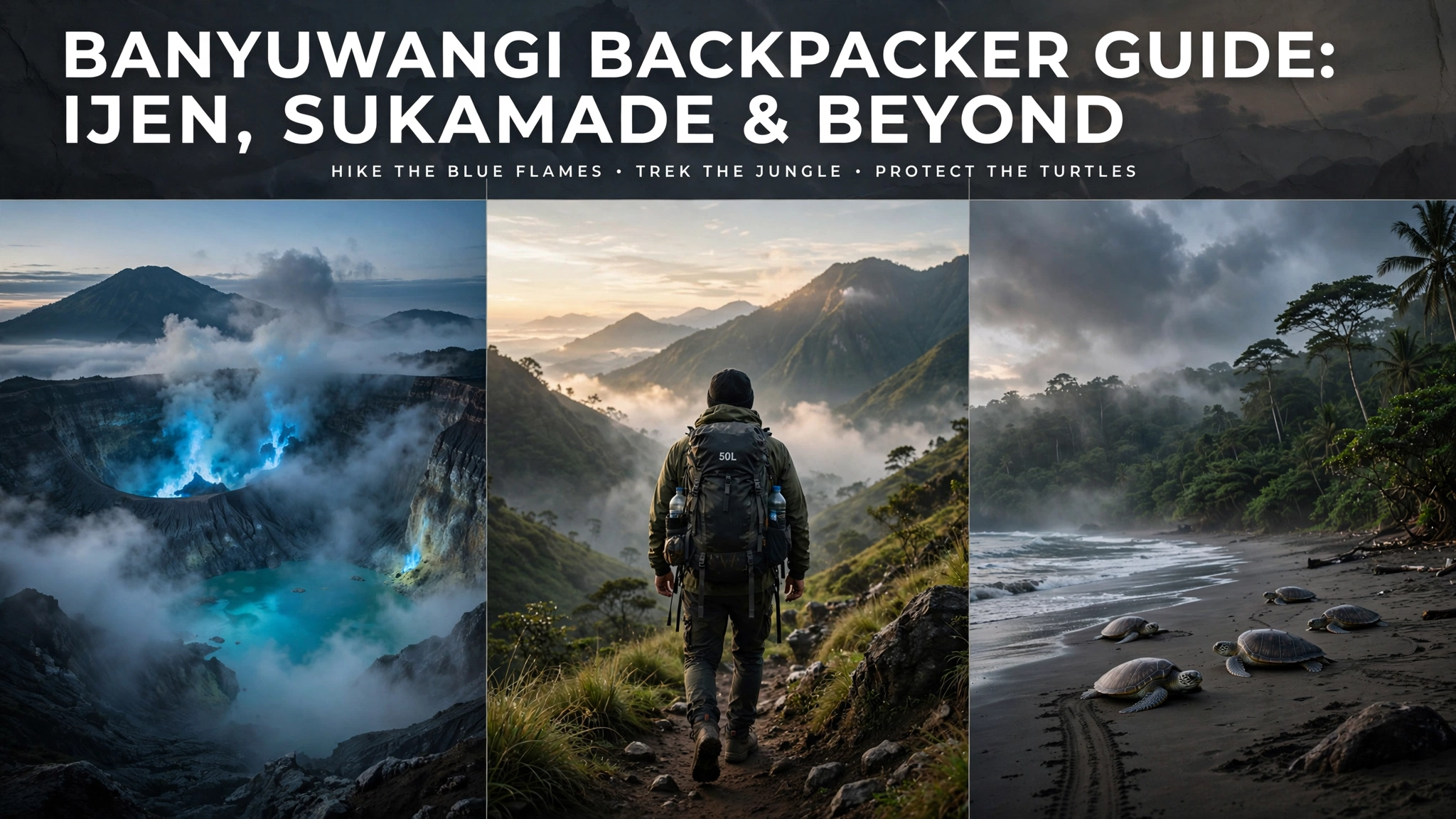
This Banyuwangi backpacker guide distills what I have learned as a local Sukamade travel consultant and conservation partner, helping independent travelers plan overland routes through East Java's wildest regency. Banyuwangi sits at the far eastern tip of Java, and within a single week you can stand above the blue fire of Ijen Crater, watch a green turtle nest at Sukamade Beach, and camp beneath the jungle waterfall of Green Bay — often for less than the cost of two nights in Bali.
Few corners of Indonesia reward slow, budget travel like this one. The roads are rough, the distances are real, and the highlights are spread out — but that is exactly why Banyuwangi still feels raw and uncrowded compared with its famous neighbor across the strait. In this guide I walk you through the route I recommend to guests every week: when to come, how to move around, what Ijen and Sukamade actually involve on the ground, realistic costs, and the conservation rules that keep this coastline wild.
Why Banyuwangi Belongs on Your Backpacker Map
Banyuwangi is one of Java's largest regencies and its most convenient overland gateway. The Ketapang ferry crosses to Gilimanuk in Bali around the clock, taking roughly one hour, which makes it easy to enter from Bali or continue east afterward.
What makes the region special is the density of contrasts:
- Ijen Crater — a turquoise acidic crater lake and the famous nocturnal blue fire
- Sukamade Beach — one of Java's most important sea turtle nesting beaches, inside Meru Betiri National Park
- Green Bay (Teluk Hijau) — a waterfall that spills almost directly onto a jungle-fringed cove
- Red Island (Pulau Merah) — a mellow surf break with a walkable islet
- Tabuhan Island and G-Land — snorkeling reefs and one of the planet's legendary left-hand waves
Because these sites are spread across the regency, most backpackers string them together over 4 to 6 days. As a consultant based on the Sukamade side, that is the itinerary I build most often.
When to Go: Timing the Banyuwangi Backpacker Route
The dry season, roughly April to October, is the sweet spot. Trails on Ijen are firmer, the blue fire is more reliable because heavy rain can dampen the sulfur gases, and the track toward Sukamade is far more passable.
That said, do not overthink the calendar for turtles. Green turtles nest at Sukamade year-round, so there is no closed season — sightings on night patrols are frequent but never guaranteed, because these are wild animals, not a show.
[!TIP] If your dates are flexible, aim for the shoulder months of April–June or September–October. You get dry-season trail conditions with fewer crowds than the July–August peak, and homestay prices stay friendlier.
Getting to Banyuwangi and Getting Around
You have three practical entry points:
- Fly into Banyuwangi Airport (BWX) at Blimbingsari, with connections through Surabaya or Denpasar.
- Train from Surabaya or Yogyakarta — the eastern Java rail line is scenic and very budget-friendly.
- Ferry from Bali via Ketapang, running 24 hours a day.
Once you are there:
- A rented scooter (typically around IDR 70,000–100,000 per day) covers the Ijen side, Red Island, and the coastal villages.
- The final stretch to Sukamade is a rough plantation track where a 4WD jeep or a guided tour vehicle is strongly advised, especially after rain.
- Public transport exists but is slow; most backpackers mix scooters with chartered transfers.
Distances to budget for: Banyuwangi city to the Paltuding trailhead (Ijen) is around 2 hours by road; Banyuwangi to Sukamade commonly takes 4 to 5 hours including the rough final section.
Ijen Crater: The Blue Fire Trek
The 2 A.M. Start
The classic plan is to leave your guesthouse around midnight to 1 a.m., reach the Paltuding trailhead, and hike the roughly 3 km path to the crater rim in about 1.5 to 2 hours. You want to be at the rim while it is still dark, because the blue fire is only visible before dawn.
The trail is steep but non-technical, and most reasonably fit backpackers manage it fine. Sulfur fumes can be strong near the gas vents, so a gas mask is recommended — they are commonly available to rent or borrow at the trailhead.
Blue Fire and the Acidic Crater Lake
The blue fire is ignited sulfuric gas escaping from fissures in the crater — an electric-blue flame that can rise several meters high in places. As the sky lightens, the view opens onto one of the world's largest highly acidic crater lakes, an unreal turquoise cauldron ringed by yellow sulfur walls.
You will almost certainly meet the sulfur miners hauling loads up the same path. Give them the right of way, ask before photographing, and consider buying a small souvenir piece at the top — it is a hard way to earn a living.
Permits, Fees, and Booking
Ijen sits inside a national park, so there is an entrance fee with separate rates for international and domestic visitors, and the figures have changed over the years. As a rough recent reference, international visitors have paid in the neighborhood of IDR 100,000–150,000, with weekend rates higher — but confirm the current fee before you go, because park pricing is revised periodically. A guide is not always mandatory for the rim hike, but during high season the blue fire viewing window can be regulated, so booking ahead saves disappointment.
[!TIP] Check the weather before committing. Heavy rain can extinguish the blue fire entirely. If your first night fails, many backpackers simply try again the next night — the trail is that accessible from Banyuwangi town.
Sukamade Beach: Night Patrol with the Turtles
Sukamade is the reason my team exists. This remote beach inside Meru Betiri National Park has been a managed turtle conservation site since the 1970s, and it remains one of the most reliable places in Java to witness sea turtle nesting in the wild.
The Night Patrol Experience
After dark, park rangers lead small groups along the beach to find nesting females. The green turtle (Chelonia mydas) is the primary nester here, with olive ridley and hawksbill turtles also recorded, and the enormous leatherback appearing only rarely.
A full nesting sequence — hauling out, digging the egg chamber, laying around 80–120 eggs, covering the nest, and returning to the sea — can take one to two hours. Rangers control lighting and positioning so the turtle is never disturbed.
Hatchling Release at Dawn
Most visits end the next morning with the hatchling release: baby turtles, often from the park's protected hatchery, are released at the waterline and sprint for the surf. By some estimates only about one in a thousand hatchlings reaches adulthood, which is exactly why protected nesting beaches like Sukamade matter.
The Road to Sukamade
Honesty time: the final ~25 km into Sukamade is a rough dirt and stone track through rubber and coffee plantations, crossing rivers and forest. In the dry season a high-clearance vehicle handles it; after heavy rain it can become genuinely difficult. This is the single biggest reason most travelers book a Sukamade Tour Package rather than attempting it solo — the operator handles the 4WD, the park permits, the ranger coordination, and the simple on-site accommodation.
[!IMPORTANT] Turtle conservation rules at Sukamade are non-negotiable:
- No flash photography and no white lights — use red-filtered light only
- Never touch, ride, or block a turtle, and stay behind the ranger's line
- Keep quiet during nesting; turtles abandon the attempt if disturbed
- No drones without explicit park permission
- Take every piece of trash back out with you
Beyond Ijen and Sukamade: Green Bay, Red Island and More
Green Bay (Teluk Hijau)
Green Bay is a short jungle trek from Rajegwesi Beach, ending at a freshwater waterfall that drops onto a green-sand cove backed by mangroves. It pairs perfectly with Sukamade because it sits on the same southeastern coastal road. If you want to sleep out here, our Green Bay Beach Camp puts tents right in the coastal forest, and the Jungle Tracking Sukamade program connects the two areas on foot with a local guide.
Red Island (Pulau Merah)
On the south coast near Pesanggaran, Red Island is the friendliest surf spot in the region — soft beach-break waves for beginners, board rentals on the sand, and a small red-soiled islet you can walk to at low tide. Sunsets here are superb, and the warungs serve fresh seafood at backpacker prices.
Tabuhan Island and G-Land
Tabuhan Island, off Bangsring, offers clear snorkeling over coral slopes and a limestone ridge. Further along the same coast lies G-Land (Plengkung), the legendary left-hand wave inside Alas Purwo National Park — not for beginners, but thrilling to watch from the jungle camps during surf season.
Sample 5-Day Banyuwangi Backpacker Itinerary
Here is the route I most often sketch for guests:
| Day | Base | Highlight |
|---|---|---|
| 1 | Banyuwangi / Licin | Arrive by train, ferry or flight; evening at Ketapang or the local market |
| 2 | Licin / Ijen area | Midnight start, Ijen blue fire trek, crater rim at sunrise, afternoon rest |
| 3 | Sukamade | 4WD transfer via Rajegwesi and Green Bay; night turtle patrol |
| 4 | Sukamade → coast | Hatchling release at dawn, return transfer, optional Red Island sunset |
| 5 | Bangsring / Bali | Snorkel Tabuhan Island, or catch the ferry to Gilimanuk |
Compress this to 4 days by dropping Tabuhan, or stretch it to 7 by adding a full jungle tracking day and a surf session at Red Island.
Backpacker Budget: What to Expect in 2026
Costs in Banyuwangi remain gentle by Indonesian standards. These are typical backpacker ranges, not quotes — always confirm current prices:
| Item | Typical Range (IDR) |
|---|---|
| Homestay / guesthouse per night | 100,000 – 250,000 |
| Meals at local warungs (per day) | 50,000 – 100,000 |
| Scooter rental (per day) | 70,000 – 100,000 |
| Ijen entrance, international visitor | around 100,000 – 150,000 (confirm current rate) |
| Sukamade trip | package-based — ask us for the current rate |
| Daily total (excluding tours) | roughly 300,000 – 600,000 |
A Sukamade trip is almost always booked as a package because it bundles the 4WD, permits, ranger fees, meals and lodging — it is rarely cheaper to piece it together yourself. For an up-to-date quote, message our team directly on Booking WhatsApp.
[!TIP] Bring cash. ATMs are reliable in Banyuwangi city and at Banyuwangi Baru station, but thin on the south coast, and Sukamade has no card payment at all.
Responsible Travel: Why the Rules Matter
Everything on this coast — the blue fire, the nesting beach, the jungle waterfall — survives because it is managed. Park fees fund rangers; ranger patrols protect nests; the hatchery gives hatchlings a fighting chance. As a conservation partner, I ask every guest to treat the rules above as part of the experience, not an inconvenience. Choose local guides, refuse single-use plastic on the beach, and never buy turtle products anywhere in Indonesia.
FAQ: Banyuwangi Backpacker Questions
How many days do I need in Banyuwangi? Four days covers Ijen plus Sukamade comfortably; five to six lets you add Green Bay, Red Island or Tabuhan Island without rushing.
Can I visit Ijen and Sukamade without a tour? Ijen is doable independently with a scooter and an entrance ticket. Sukamade realistically requires a 4WD and park coordination, so a guided package is the practical — and usually cheaper — option.
When is turtle nesting season at Sukamade? Green turtles nest year-round, so there is no single season. Night patrols run regularly, but sightings depend on the turtles themselves.
Is the road to Sukamade really that bad? The final stretch is unpaved plantation track — fine in dry weather with a high-clearance vehicle, challenging after rain. It is the main reason tours use jeeps.
Will I definitely see the blue fire at Ijen? No. It depends on gas activity and weather; rain can extinguish it. Dry-season nights give you the best odds, and a second attempt is cheap if your first fails.
Is Banyuwangi safe for solo travelers? Yes — it is one of the more relaxed corners of Java. Standard precautions apply: watch your belongings on ferries, tell your homestay your route, and ride scooters defensively.
What should I pack? A warm layer for Ijen (the rim is cold before dawn), a headlamp with red light mode for Sukamade, a rain shell, cash, reef-safe sunscreen, and sturdy shoes for the crater trail.
Plan Your Banyuwangi Route
Banyuwangi rewards the backpacker willing to trade a little comfort for a lot of wild. Hike in the dark, stand above a burning crater, sleep to the sound of the surf, and watch hatchlings make their first dash to the ocean. If you want help stitching the route together, browse more field notes on our Blog or reach our team any time via Booking WhatsApp — we answer route questions even if you travel fully independent.
S
Written by Sea Turtle Tours
Local Sukamade Travel Consultant & Conservation Partner