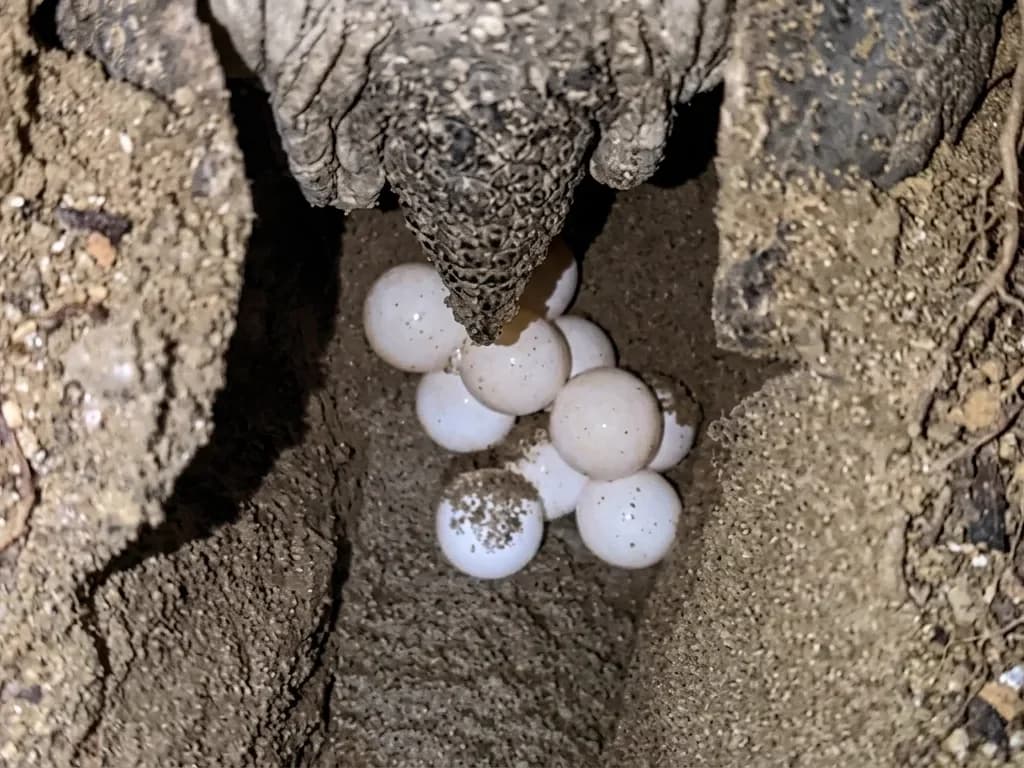
4 Sea Turtle Species Found at Sukamade
Sukamade Beach is a globally significant sea turtle nesting sanctuary located within Meru Betiri National Park, East Java, Indonesia. It is one of Southeast Asia's rare multi-species rookeries hosting four distinct marine turtle species: Green Sea Turtle (*Chelonia mydas*), Olive Ridley (*Lepidochelys olivacea*), Hawksbill (*Eretmochelys imbricata*), and Leatherback (*Dermochelys coriacea*), safeguarded under continuous scientific monitoring by Balai Taman Nasional Meru Betiri (TNMB) (https://merubetiri.id) and aligned with IUCN Marine Turtle Specialist Group (https://www.iucn-mtsg.org/) standards.
Species: 4 of the world's 7 sea turtle species
Location: Sukamade Beach, Meru Betiri, Banyuwangi
Most Common: Green Turtle (±70% of nests)
Rarest: Hawksbill (5–15 nests/year)
Here is a detailed look at each species that calls Sukamade home.
Most Indonesian nesting beaches host only one or two species. Sukamade's four-species diversity is what makes it exceptional — and why this stretch of sand is protected within Meru Betiri National Park.
- Green Turtle (Chelonia mydas (https://www.iucnredlist.org/species/4615/11037468))
Status: Endangered (https://www.iucnredlist.org/species/4615/11037468) (IUCN Red List)
The Green Turtle is the most common nester at Sukamade, accounting for approximately 70% of all nests found on the beach each season. Adult greens are large — shell length up to 1.2 meters and weight up to 190 kilograms.
Despite their name, Green Turtles are not green on the outside. Their shell is usually brown or olive with radiating patterns, and their skin is dark brown. The name comes from the green color of their fat, caused by their herbivorous diet of seagrass and algae.
Unique to Sukamade: The Green Turtles here are part of a genetically distinct population that nests primarily on Java's south coast. Tagging programs have tracked Sukamade greens as far as the waters off Western Australia and the Arafura Sea.
Nesting behavior: Greens prefer the central section of Sukamade beach, where the sand is deeper and the forest canopy provides better cover. A single female nests every 2-4 years but lays multiple clutches (4-7) within a single season, about 14 days apart. Each clutch contains 100-120 eggs.
- Olive Ridley Turtle (Lepidochelys olivacea (https://www.iucnredlist.org/species/11534/3292503))
Status: Vulnerable (https://www.iucnredlist.org/species/11534/3292503) (IUCN Red List)
The Olive Ridley is the smallest sea turtle species found at Sukamade, reaching only 60-70 centimeters in shell length and weighing 35-50 kilograms. Its olive-colored, heart-shaped carapace gives it both its common and scientific names.
Olive Ridleys are famous for their mass nesting events, known as arribadas, where thousands of females come ashore simultaneously. While Sukamade does not host arribadas on the scale of Costa Rica or India (where 100,000+ turtles may nest in a single night), the beach does see localized mass nesting events with 50-100 turtles in a single evening during peak season.
Distinctive feature: Olive Ridleys have a unique scale arrangement on their shell — five or more pairs of costal scutes, which distinguishes them from the similar Kemp's Ridley.
Nesting behavior: At Sukamade, Olive Ridleys nest from November to February, often preferring the eastern end of the beach near the river mouth. They lay slightly smaller clutches than greens — approximately 80-110 eggs per nest.
- Hawksbill Turtle (Eretmochelys imbricata (https://www.iucnredlist.org/species/8005/12881238))
Status: Critically Endangered (https://www.iucnredlist.org/species/8005/12881238) (IUCN Red List)
The Hawksbill is the rarest regular nester at Sukamade, with only 5-15 nests recorded annually. Named for its narrow, pointed beak resembling a hawk's bill, this species is critically endangered worldwide due to the tortoiseshell trade.
Hawksbills are medium-sized, with a shell length of 70-90 centimeters and weight of 45-70 kilograms. Their shells display overlapping scutes with a stunning amber, brown, and orange pattern — the source of the "tortoiseshell" that poachers have hunted them for over centuries.
Diet: Unlike greens, Hawksbills are spongivores — they feed almost exclusively on sponges found on coral reefs. This specialized diet makes them essential for reef health, as they control sponge populations that would otherwise outcompete corals.
Nesting behavior: At Sukamade, Hawksbills nest in low numbers but with remarkable consistency. The same few females return year after year to the same section of beach. They prefer nesting higher up the beach, closer to the vegetation line, than other species. Their tracks are distinctive — asymmetrical, with the tail dragging between the flipper marks.
- Leatherback Turtle (Dermochelys coriacea (https://www.iucnredlist.org/species/6494/43526147))
Status: Vulnerable (https://www.iucnredlist.org/species/6494/43526147) (IUCN Red List)
The Leatherback is the largest turtle on Earth and the most extraordinary visitor to Sukamade. Adults can reach 2 meters in length and weigh up to 700 kilograms — larger than most humans realize.
Unlike all other sea turtles, the Leatherback has no hard shell. Instead, its carapace is covered with a leathery, oil-saturated skin stretched over thousands of tiny bone plates. Seven prominent ridges run lengthwise along the back, giving it a distinctive, almost prehistoric appearance.
Migration: Leatherbacks are the most migratory of all sea turtles. Sukamade's Leatherbacks are believed to travel from feeding grounds as far away as the North Pacific, off the coasts of Alaska and California, where they feed on jellyfish.
Rarity at Sukamade: Leatherback nests are rare at Sukamade — perhaps 1-5 per season in good years, and sometimes none in a given year. Scientists are not fully sure why this population has declined so steeply. Incidental capture in fishing gear, plastic ingestion (jellyfish-eating Leatherbacks frequently mistake plastic bags for prey), and climate shifts affecting sand temperatures are all contributing factors.
Nesting behavior: When they do nest, Leatherbacks prefer the most open, unobstructed sections of beach. They dig deeper nests than other species — up to 80 centimeters — to reach the cooler sand layers preferred by their embryos. Their tracks are unmistakable: a wide, symmetrical body imprint with deep pits left by their powerful front flippers.
How Researchers Study Turtles at Sukamade
The conservation program at Sukamade is built on decades of systematic data collection. Every interaction with a nesting turtle adds to a scientific record that now spans more than 40 years.
The cornerstone of the research is the tagging program. When a female turtle comes ashore to nest, rangers apply a metal flipper tag bearing a unique identification number. For larger turtles, especially Greens and Leatherbacks, they also insert a passive integrated transponder (PIT tag) — a tiny microchip similar to those used for pet identification — beneath the skin. This dual-tagging system ensures that if one tag is lost, the turtle remains identifiable across seasons and even across oceans.
Before the turtle returns to the sea, researchers take a series of measurements. Carapace length and width are recorded using specialized calipers, along with notes on any injuries, tumors, or unusual markings. These measurements help track individual growth rates and body condition when the same turtle is encountered in subsequent nesting seasons.
Every nest is documented in detail. Rangers record the clutch size (number of eggs), the depth and location of the nest chamber, and the distance from the high tide line. Nests laid too close to the water or in areas vulnerable to erosion are carefully relocated to the hatchery for protection. After approximately two months of incubation, each nest is excavated to count hatched and unhatched eggs, calculating the hatching success rate — a key indicator of both nest viability and overall beach conditions.
In recent years, the program has expanded to include satellite tracking. A small, harmless transmitter is attached to selected turtles before they depart from Sukamade, allowing researchers to follow their post-nesting migrations across thousands of kilometers. These tracks have revealed foraging grounds in the Arafura Sea, the waters off northern Australia, and the open Indian Ocean — information that is critical for designing international conservation strategies that protect turtles beyond Indonesian waters.
Threats Facing Sea Turtles at Sukamade
Despite the protected status of Meru Betiri National Park, the sea turtles that nest at Sukamade face a range of serious threats both on the beach and at sea. Understanding these pressures is essential to appreciating the full picture of conservation work happening here.
Egg poaching was historically the greatest danger to Sukamade's turtles. Before the national park established its permanent ranger station in the 1980s, collectors would dig up nearly every nest on the beach, selling the eggs in Banyuwangi and beyond. Today, round-the-clock ranger patrols during nesting season have reduced poaching to near zero. The rangers know the beach intimately and can spot the subtle signs of a disturbed nest within hours of it being tampered with.
Bycatch in fishing nets remains a serious threat, especially for the highly migratory Leatherback and Olive Ridley species. Turtles foraging off the Java coast are caught accidentally in gillnets and longlines set by local fisheries. The national park partners with fishing communities in Sarongan and adjacent villages to promote turtle-friendly fishing practices, including the use of turtle excluder devices (TEDs) that allow turtles to escape nets, and rapid release techniques for accidentally caught turtles.
Plastic pollution affects foraging grounds throughout the Indian Ocean. Leatherbacks are especially vulnerable because they cannot distinguish between jellyfish and floating plastic bags — ingestion is often fatal. Microplastics accumulating in the seagrass beds where Green Turtles feed are another growing concern. The park runs regular beach cleanups and enforces a strict policy requiring all visitors to remove every piece of waste they bring in.
Climate change poses a longer-term and potentially existential threat. Sea turtle sex is determined by sand temperature during incubation — warmer sand produces more females, cooler sand produces more males. Rising global temperatures are skewing hatchling sex ratios toward near-100% female at some nesting sites worldwide. At Sukamade, rangers have begun experimenting with shaded sections of the hatchery to maintain cooler incubation temperatures and preserve more balanced sex ratios.
Light pollution from coastal development disorients both nesting females and hatchlings. While Sukamade itself remains mercifully dark, glow from distant fishing boats and the growing tourism infrastructure along Java's south coast can confuse turtles navigating toward the ocean after nesting. The park enforces strict light discipline during patrols and advocates for turtle-friendly lighting practices in nearby communities.
Why Sukamade Matters
Four species nesting on one beach is exceptional. The combination of Sukamade's remote location, protected status within Meru Betiri National Park, and the long-term commitment of local rangers has created a sanctuary that is increasingly rare in Southeast Asia.
The conservation station at Sukamade has been monitoring these turtles since the 1980s. Their data shows that while Green Turtle nests have remained relatively stable, Olive Ridley and especially Leatherback numbers have declined. Every season without a Leatherback nest is another reminder of what is at stake.
How You Can Help
Visiting Sukamade responsibly supports conservation directly. Park entry fees fund ranger patrols, the hatchery program, and community education. Simple actions during your visit — no flash photography, keeping noise down during night patrols, staying behind the marked zone near nesting turtles — reduce stress on the animals and improve their nesting success.
For those who want to do more, the volunteer program at Sukamade offers hands-on involvement: patrolling the beach, relocating at-risk nests, measuring and tagging turtles, and releasing hatchlings.
Learn the best time to visit Sukamade (/blog/best-time-to-see-turtles-at-sukamade-beach) to maximize your chances of spotting each species during your trip.
FAQ
Q: How many turtle species nest at Sukamade?
A: Four: Green, Olive Ridley, Hawksbill, and Leatherback. Most Indonesian beaches have only one or two species.
Q: Which species is seen most often?
A: Green turtles — about 70% of all nests at Sukamade each season. Almost guaranteed to be seen on a peak-season night patrol.
Q: When is the best time to see a Leatherback?
A: Leatherbacks are rare visitors — only 1–5 nests per year, usually November–January. Seeing one is considered the most special moment.
Q: Are all four species protected?
A: Yes. Green turtles are Endangered, Olive Ridleys and Leatherbacks Vulnerable, and Hawksbills Critically Endangered on the IUCN Red List.
"We were lucky to see a Green and an Olive Ridley in one night. The ranger explained every detail — from telling tracks apart to turtle ages." — Tourist from Surabaya, visited February 2026
Contact us on WhatsApp — https://wa.me/6282143034582?text=Hi!%20I'm%20interested%20in%20joining%20the%20Ranger%20Activities%20program%20for%20a%20night%20patrol

Local travel consultant in Sarongan Village, Meru Betiri National Park. We plan authentic, responsible turtle tours — 4x4 jungle access, ranger night patrols, and hatchling releases — with local guides who live here.